
BIG UPDATE: 3200+ General Line Teacher Vacancies in Jammu & Kashmir
The Government of J&K has identified 3200+ Teaching posts to be referred to JKSSB shortly. Get ready for one of the biggest teaching recruitments of 2025.
3200+
General Line Teacher
Graduate in any discipline (as per JKSSB norms)
Jammu & Kashmir Services Selection Board (JKSSB)
Mode of Selection: Written Test (85 Marks) + Higher Qualification (15 Marks).
Exam Level: UT-Level Competitive.
Expected Notification: Early 2025 — Check latest updates here.
The Government of Jammu & Kashmir has officially identified 3200+ General Line Teacher posts, which will soon be referred to JKSSB. This makes it one of the biggest teaching recruitments of 2025. As seen in the past, teaching vacancies attract extremely high participation, and this year more than 2 lakh candidates are expected to apply.
If you have been following the updates on the Upcoming JKSSB Teacher Recruitment 2025, you already know that the competition will be intense. That’s why starting your preparation early is the smartest decision you can make. Early preparation gives you more time to understand the syllabus, revise NCERT basics, and strengthen accuracy.
This article explains in simple, clear language what aspirants need to know about the JKSSB Teacher Syllabus 2025 and the exam pattern. You will get a full breakdown of the marks, section-wise topics, preparation advice, and important points to remember. In this article, we cover the following
- Full exam pattern for the General Line Teacher post (marks & structure)
- Detailed, topic-wise syllabus for the written test (exact topics as per the official PDF)
- Practical preparation tips and study strategy
- Important reminders, internal links, and SEO assets
JKSSB Teacher Exam Pattern 2025
Written Test: 85 marks
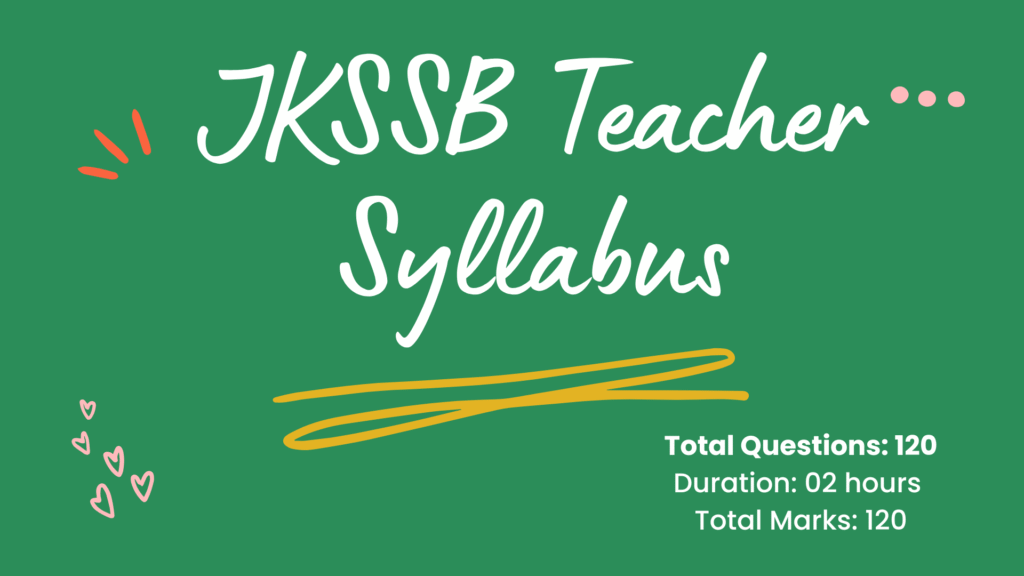
- The written paper is objective (multiple-choice) and tests subject knowledge, reasoning, language and general awareness. The official pattern indicates a total time of 120 minutes with 120 marks/questions in some published drafts; for the merit calculation, JKSSB will consider 85 marks from the written component as per the notification structure. (Always check final notification for exact number of questions and duration.)
Higher Qualification (15 Marks)
JKSSB awards 15 points for higher academic qualifications beyond the basic graduation degree. The breakup is as follows:
- B.Ed – 5 Points: Bachelor of Education (B.Ed) adds 5 marks to your final score.
- M.Ed – 5 Points: Master of Education (M.Ed) also carries 5 marks.
- Post Graduation (PG – 2 Years) / Integrated PG (5 Years) – 2 Points: Whether you hold a 2-year PG degree or a 5-year integrated PG, you will receive 2 marks.
- M.Phil – 1 Point: Candidates with an M.Phil degree get 1 mark.
- PhD – 2 or 3 Points
- PhD after completing M.Phil → 2 points
- Direct PhD (without M.Phil) → 3 points
These 15 points are added after your written exam marks (out of 85), making the total final score 100 marks.
Detailed JKSSB Syllabus for General Line Teacher Written Test
The JKSSB Teacher written test covers a broad range of school education topics plus general ability areas. It assesses your language skills (English), analytical reasoning, general awareness (national, international, J&K specific), computer basics, and subject knowledge including environmental science, geography, history, polity and economics. The aim is to test whether a candidate has the knowledge, reasoning ability and communication skills required for classroom teaching and school-level administrative tasks.
| Section | Topics Covered (complete list) | Marks |
|---|---|---|
| 1. Verbal Ability | Articles; Verbs; Tenses; Prepositions; Synonyms & Antonyms; Punctuation; Reading Comprehension; Cloze Passage; Grammar; Idioms & Phrases. | 15 |
| 2. Analytical Ability | Letter Series; Number Series; Relationship Concepts; Direction Sense; Concept of Speed–Time–Distance; Coding–Decoding; Analogy; other qualitative reasoning items. | 15 |
| 3. General Awareness & Current Affairs | Important dates; “Firsts” (World/India/J&K); Books & Authors; Languages; Capitals & Currencies; International & National Awards; Sports; Government schemes and policies; Major national and international current events; J&K specific facts where relevant. | 10 |
| 4. Basics of Computers and its Usage | Fundamentals of Computer; Memory; Operating Systems; MS Office (Word, Excel, PowerPoint, Access); Internet browsers; Email and practical digital skills; emerging Digital India trends. | 10 |
| 5. Environmental Science | Climate change; Natural resources; Energy & pollution; Interaction of plants and animals; Living and non-living components of environment; Formation and structure of earth; Environmental issues and their impact on health and society. | 10 |
| 6. Geography | Physical, Social and Economic Geography of India and J&K; World geography sections—Continents, Oceans, Mountain ranges, Important rivers and lakes, Islands, Important cities and capitals; Conservation areas, national parks and wildlife sanctuaries. | 15 |
| 7. History | Modern Indian history; Major dynasties; Revolt of 1857 (causes & effects); Rise of the National Movement; Important dates and events of the freedom struggle; Post-independence history of India. | 15 |
| 8. Polity | Indian Constitution (basic features); Constitution of J&K (as applicable); Parliament and State Legislatures; Forms of Government; Elections; Constitutional bodies; International organizations (UNO, SAARC, ASEAN). | 15 |
| 9. Economics | Basic economic concepts: Meaning, scope and methodology; Economic growth and measurement; Five Year Plans and planning institutions; Inflation & deflation; Concepts of National Income; NITI Aayog; Economic policies of India; Taxes and subsidies; Globalization and related topics. | 15 |
How to Read & Use This Syllabus
- Prioritize high-mark sections: Geography, History, Polity and Economics often carry heavier weight in knowledge-based exams. Allocate more study time to these.
- Verbal ability is scoring: Regular reading, comprehension practice and grammar drills will quickly improve your score.
- Daily current affairs: Make short, J&K-focused notes. Government schemes and state-related facts frequently appear.
- Practice reasoning: Short daily sets of series, coding-decoding and direction sense will build speed.
- Computer basics: Hands-on practice in MS Word/Excel/PowerPoint will pay off more than theoretical reading.
- Environmental science: Focus on core topics like pollution, climate change, and conservation — short conceptual notes help.
- Mock tests: Take full-length mock tests under timed conditions to build stamina for the 120-minute paper.
Important Points
- The final official notification may include small changes to marks, duration or negative marking , always confirm with the JKSSB portal.
- Higher qualification marks (15) are important: if you hold relevant higher degrees/certificates, ensure correct documentation during verification.
- Competition will be intense — consistent effort wins over last-minute cramming.
Final Words
The JKSSB Teacher Syllabus 2025 covers diverse subjects – from reasoning and language skills to history, polity, and environment.
Early preparation is crucial because of the huge number of applicants.
Stay consistent, revise regularly, and track updates through JKSSB Teacher Recruitment 2025 .
For Official Updates, you should check the Official JKSSB Website from this link


Pingback: JKSSB Teacher Vacancy 2026: 12,977 Posts — Complete Guide - JKSSB Teacher Recruitment 2026